Why Sleeping on Your Left Side May Help With Acid Reflux
Acid reflux can turn a peaceful night into an uncomfortable experience. A burning sensation in the chest, a sour taste in the mouth, or the feeling of stomach acid rising into the throat can make it difficult to fall asleep and stay asleep. While diet and medication often play an important role in managing these symptoms, one simple lifestyle change may also help: sleeping on your left side.
Research suggests that your sleeping position can influence how easily stomach contents flow back into the esophagus. For people who experience nighttime acid reflux, changing sides may be a small adjustment that makes a meaningful difference.
What Is Acid Reflux?
Acid reflux occurs when stomach contents, including stomach acid, flow backward into the esophagus, the tube that carries food from the mouth to the stomach.
Normally, a muscular ring called the lower esophageal sphincter helps prevent this backward flow. When this muscle relaxes at the wrong time or does not close properly, stomach contents can move upward and irritate the esophageal lining.
Common symptoms include heartburn, regurgitation, a sour taste in the mouth, and discomfort after meals. When reflux occurs frequently or causes troublesome symptoms, it may be associated with gastroesophageal reflux disease (GERD).
Nighttime reflux can be particularly uncomfortable because lying down removes some of gravity’s assistance in keeping stomach contents where they belong.
Why Sleeping on Your Left Side May Help
The explanation has a lot to do with the position of the stomach and esophagus.
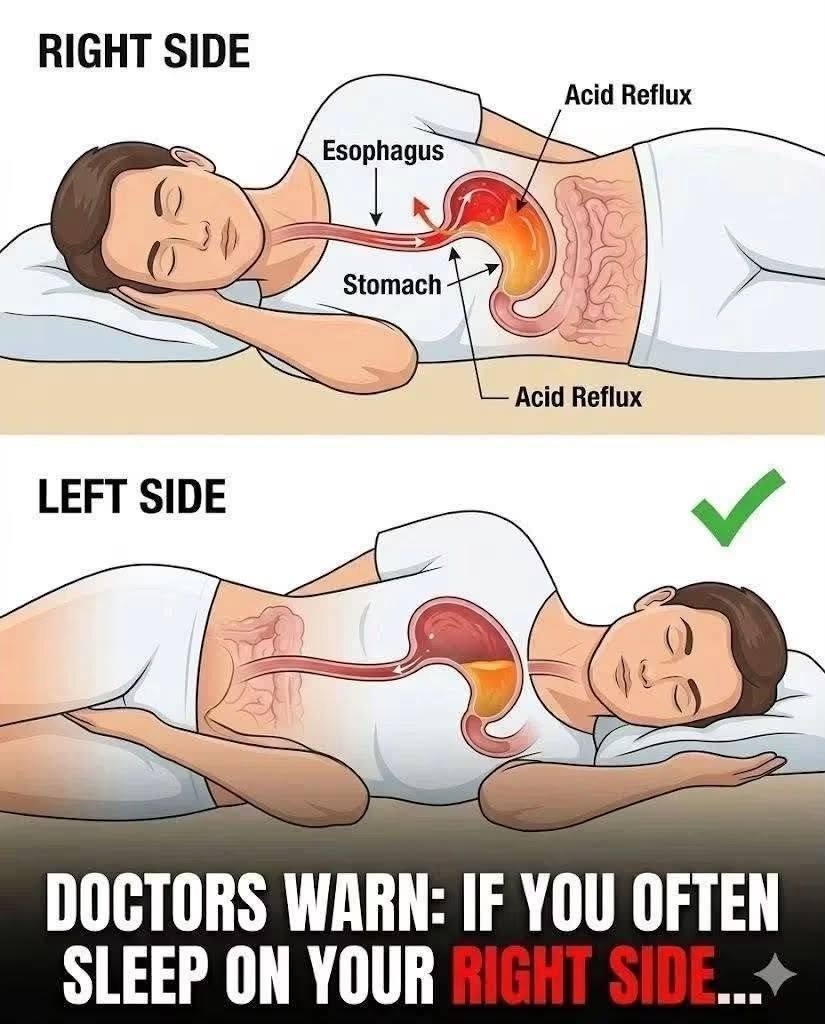
The stomach sits largely on the left side of the upper abdomen, while the esophagus connects to its upper portion. When you lie on your left side, the stomach’s contents tend to remain below the junction between the stomach and esophagus.
This positioning may make it more difficult for stomach acid to flow upward. It can also help refluxed acid clear from the esophagus more quickly.
By comparison, lying on the right side can place stomach contents in a position that makes reflux easier and may prolong acid exposure in the esophagus.
A systematic review and meta-analysis published in 2023 found that left-side sleeping was associated with reduced esophageal acid exposure and faster acid clearance compared with right-side and flat-on-the-back positions. The researchers also found evidence that positional therapy could improve nighttime reflux symptoms, although they noted that more research is needed.
What Does the Research Say?
Scientific evidence supports left-side sleeping as a useful strategy for managing nighttime reflux.
A study published in the American Journal of Gastroenterology in 2022 monitored sleep positions and esophageal acid exposure in people undergoing reflux testing. Researchers found that acid exposure was lower and acid cleared more quickly when participants lay on their left sides than when they lay on their right sides or backs.
Clinical guidelines for GERD also recognize sleeping on the left side as a potentially helpful lifestyle measure.
However, sleeping position is not a cure for GERD. The available research supports it as one part of a broader approach to symptom management, and individual results may vary.
How to Sleep on Your Left Side for Better Results
If nighttime heartburn is a recurring problem, a few practical adjustments may help you get started.
1. Begin the night on your left side. Make this your preferred starting position rather than deliberately sleeping on your right side. You do not need to remain perfectly still all night for the habit to be worthwhile.
2. Use pillows for support. A pillow between your knees and one that supports your head and neck comfortably may help you maintain a relaxed side-sleeping position.
3. Elevate your upper body if needed. If you regularly experience reflux while lying down, consider a wedge pillow designed to raise your upper torso. Raising the head end of the bed can also help. Simply stacking several ordinary pillows may bend the body in a way that is less effective.
4. Avoid lying down immediately after eating. Try to finish your evening meal at least three hours before bedtime. This gives your stomach time to digest food before you lie down.
5. Notice your personal triggers. Large meals and certain foods or drinks may aggravate symptoms. Commonly reported triggers include fatty foods, chocolate, coffee, spicy foods, and acidic foods. Rather than avoiding everything, pay attention to which items consistently affect you.
Other Habits That May Reduce Nighttime Acid Reflux
Changing your sleeping position works best when combined with other appropriate lifestyle measures.
Eating smaller evening meals may help reduce pressure and discomfort in the stomach. Maintaining a healthy weight, when appropriate, can also reduce reflux symptoms. Avoiding smoking and identifying foods that trigger your symptoms may provide additional benefits.
If symptoms persist, a healthcare professional can help determine whether medication or further evaluation is needed. Do not stop prescribed reflux medication simply because you begin sleeping on your left side.
When Should You See a Doctor?
Occasional heartburn is common, but frequent or persistent reflux deserves attention. Speak with a healthcare professional if symptoms occur regularly, disrupt your sleep, or do not improve with lifestyle changes.
Seek urgent medical attention for chest pain that is severe, new, or unexplained, especially when accompanied by shortness of breath, sweating, or pain spreading to the arm or jaw. Difficulty swallowing, vomiting blood, or black stools also require prompt medical assessment.
These symptoms should not automatically be attributed to acid reflux.
The Bottom Line
Sleeping on your left side may be a simple, low-cost way to reduce nighttime acid reflux. By changing the relationship between your stomach and esophagus, this position can help limit acid exposure and support faster clearance of refluxed contents.
For many people, the best approach combines left-side sleeping with sensible meal timing, appropriate upper-body elevation, and medical treatment when necessary.
A small change in how you sleep may not solve every digestive problem, but if nighttime heartburn is affecting your rest, trying your left side could be a worthwhile first step.
Medical disclaimer: This article is for educational purposes only and is not a substitute for professional medical advice.
References
Simadibrata DM, et al. “Left lateral decubitus sleeping position is associated with improved gastroesophageal reflux disease symptoms: A systematic review and meta-analysis.” World Journal of Clinical Cases, 2023. https://pubmed.ncbi.nlm.nih.gov/37969463/
Katz PO, et al. “ACG Clinical Guideline: Guidelines for the Diagnosis and Management of Gastroesophageal Reflux Disease.” American Journal of Gastroenterology, 2022. https://pmc.ncbi.nlm.nih.gov/articles/8754510/